Count studs and plates from the PDF.
This page is for framers and mixed GCs who still bid wood or metal stud work from someone else’s PDF. You do not want a black-box board-foot. You want stud walls from wall LF, plates at three times that length, headers from the opening schedule, sheathing converted to 4x8 sheets, and the engineered lumber schedule transcribed — not re-invented. If an I-joist or LVL layout is on the set, the product’s job is to copy it, not to second-guess Boise.
The trade-contractors page is the customer version of “bid your slice.” This page is the Framing scope: 2x4 versus 2x6, 16 inch O.C. as 0.75 studs per LF plus corners, T’s, and openings, Simpson connectors from the summary, dimensional waste at 10 percent, engineered at zero. Filter to Framing on upload if the invitation is walls only.
Solo at $200 is five successful takeoffs. Crew at $399 is fifteen and is the featured plan (Most Popular: Full Bid Loop). Shop at $699 is forty. RFQs are on every plan, so a GC can hang the walls and still send plumbing out. Failed runs do not count.
The problem
Framing takeoffs die in two places. Measuring tools make you click every stud run, then you still type the count into a lumberyard sheet. AI lists that dump “2x4 studs — 400” without the sheet, without 2x4 versus 2x6, and without saying whether that number already includes waste, will be rebuilt on Saturday.
Engineered members are worse. If the model re-estimates an I-joist layout that already has PlotIDs, you will order the wrong lengths. Connectors from a Simpson summary that were not transcribed become a truck you did not budget.
Sunday-Off is written for that rebuild: still doing manual takeoffs on Sunday night after 30 days? Full refund.
What you get
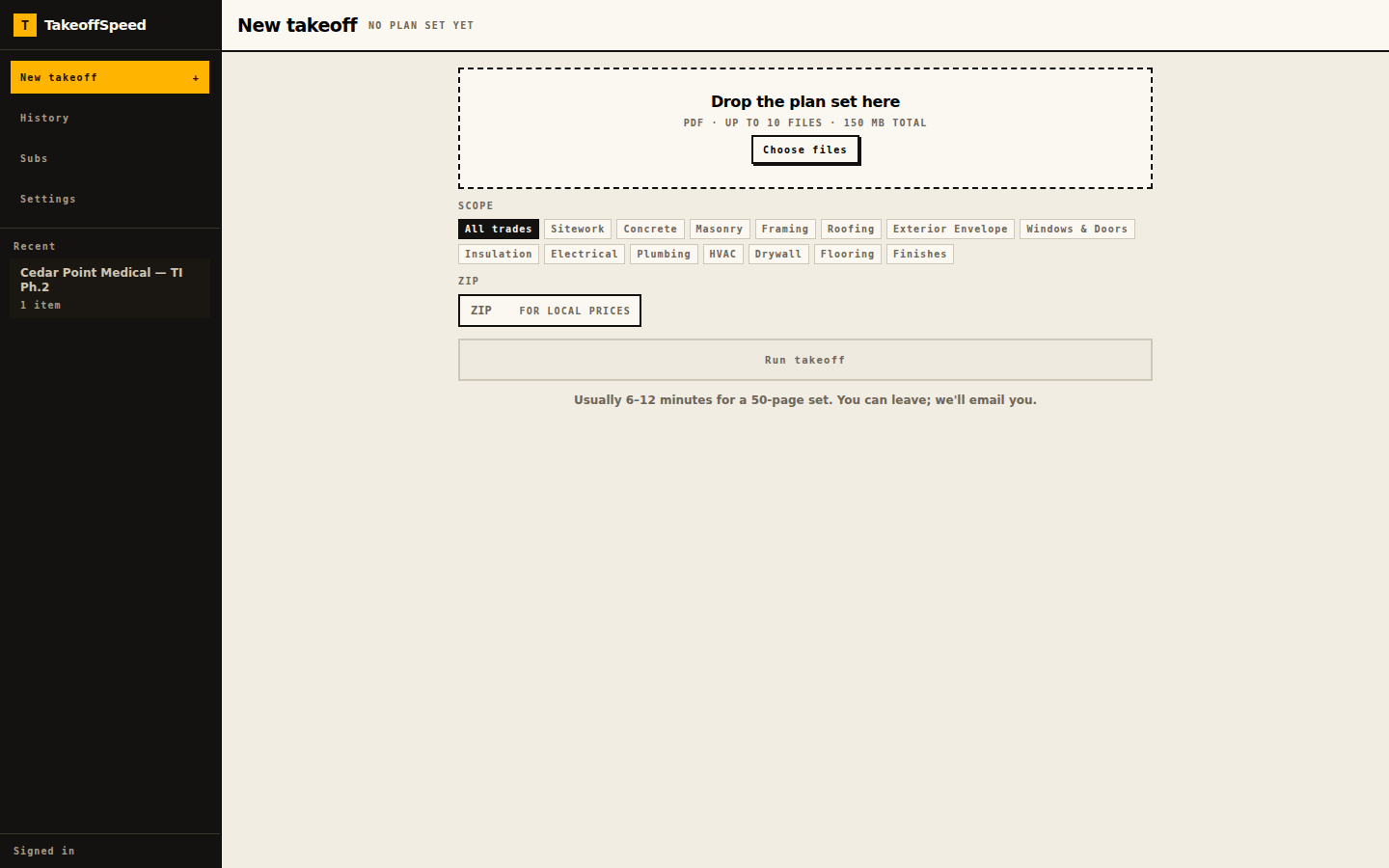
Upload the PDF. Chip Framing — or leave all fourteen scopes. Type the job ZIP. Run takeoff. Processing time varies with plan size and complexity. We email you when the first pass is ready.
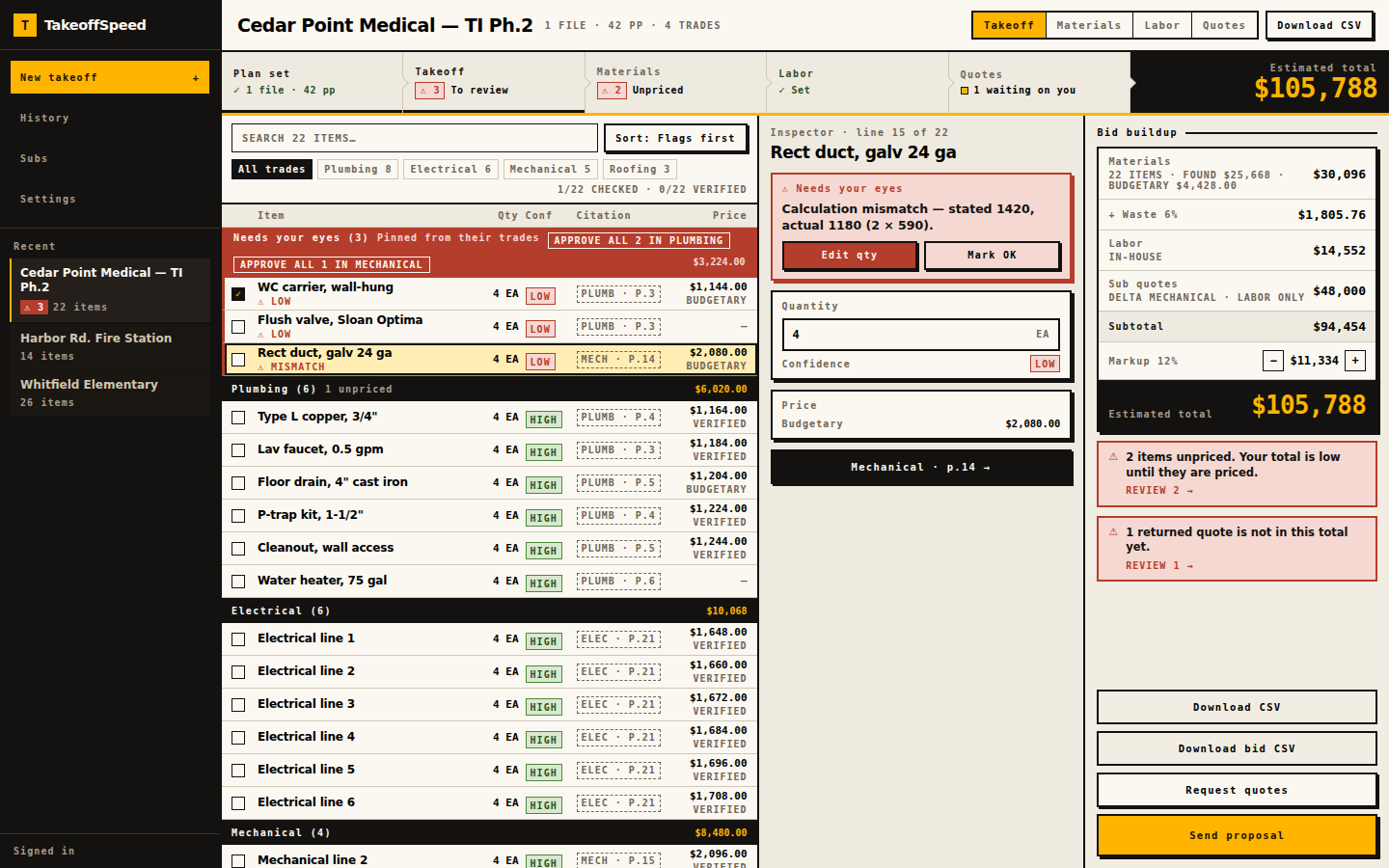
Review Framing as its own group. High-confidence lines should open a page chip. Studs, plates, headers, sheathing, fasteners, and transcribed engineered pieces should be separate rows, not one “lumber” lump. Edit quantity, unit, and spec when the drawing disagrees. Then price SELF materials, mark SUB if you buy the hang, send a guest RFQ, and export. Dimensional waste belongs on the line as arithmetic you can check, not a silent pad.
See how it works if you want the screens first. Then run your first bid. First-takeoff refund via feedback@takeoffspeed.io. Sunday-Off after 30 days. Cancel anytime. Failed runs do not count. We do not run your company. We help you get the bid out.
- Upload the plans.
- Review the takeoff and supporting evidence.
- Price self-performed materials.
- Send RFQs for subcontracted scope.
- Bring the returned quotes into the bid.
- Check coverage and avoid double-counting.
- Assemble and send the proposal.
In the product
What this supports
Upload is PDF-only, ten files, 150 MB on the drop; the server accepts up to 200 MB. The current page allowance is shown before upload. Large or dense sets may still exceed processing limits. Framing is one of fourteen scopes from Sitework through Finishes. A filtered run still comes back grouped; you still review.
The takeoff prompt itemizes stud walls (LF × studs per foot, 16 inch O.C. = 0.75/LF plus corners, T’s, openings), plates (3× wall LF to stock lengths), headers from schedule or opening chart, sheathing SF → 4x8 sheets (32 SF) rounded up with 10 percent waste, fasteners by type, and Simpson quantities transcribed from a connector summary. Engineered lumber schedules are copied, not re-estimated. Waste on dimensional lumber is 10 percent; engineered is 0 percent — order exact from the schedule.
Citations, HIGH / MED / LOW, Needs your eyes. Source, SELF versus SUB, guest RFQs on Solo, Crew, and Shop. Bid math is one integer-cents function. CSV and Word in-product.
Sample output
The ungated example at /sample-bid is the golden tenant fit-out the tests pin — ZIP 34420, estimated total $196,682.14 from computeBidTotals, additional contingency 10%, markup 15%. It is not a second invented house.
Framing on that fixture is Metal Framing & Partitions: 3-5/8 inch and 6 inch metal studs, tracks, slip clips, strap blocking, fasteners, plywood backing, security mesh. It is a tenant interior, not a wood-frame house with an LVL schedule. We do not invent dimensional lumber on top of that run. Plan-page source is empty on the fixture’s takeoff lines; live takeoffs include available page references for review. CSV and Word stay disabled until you sign in.
What this does not do
No scheduling, no payroll, no change-order log. We do not run your company. We help you get the bid out.
A human reviews every line. We do not claim every stud is counted. LOW or no-evidence rows stay visible. We do not claim a lumberyard match on every SKU. FOUND is listed retail at run time, not your negotiated framing package. Suggested labor on SELF is an allowance, not a framer’s bid.
Your first subscription: one free takeoff in a 14-day trial. A credit card is required. Cancel before trial end to avoid billing. Refunds on first-takeoff and Sunday-Off are manual at feedback@takeoffspeed.io. Cancel anytime.
Questions
Will the product re-estimate an engineered lumber schedule that is already on the set?
How are stud counts supposed to be built from wall length?
Can I run Framing alone on a thick multi-trade set?
Does a framing shop need Crew to send an RFQ for hangers?
Keep going
- AI Construction Takeoff and Bidding Software
- How the Plan-to-Bid Loop Works
- Pricing
- Takeoff and Bidding Software for General Contractors
- Sample Bid
- Bidding Software for Trade Contractors
- Construction Takeoff Software for PDF Plans
- Drywall Takeoff Software for Wall and Ceiling Sheets
- Concrete Takeoff Software by Placement