The shop that still bids after the field day.
This page is for the owner-operator who still bids after the field day. You may have a helper. You do not have a person whose only job is estimating. The permit set arrives as a PDF. You open it — often from the kitchen table — after you have already been on site. The homepage already says solo shops have their own page. This is that page.
Volume is a handful of meaningful bids a month, not a twenty-job desk. Solo at $200 is five successful takeoffs in a calendar month. Crew at $399 is fifteen and is the featured plan (Most Popular: Full Bid Loop) when the month is busier. Shop at $699 is forty. RFQs are on every plan, including Solo: you can hang the drywall yourself and still send plumbing out. GC bid desks, hired estimators, remodelers, and trades that bid their own work have sibling pages. You want a browser workflow, no desktop install, and no payroll-and-schedule migration.
The problem
The bid is not one document. It is a PDF, a spreadsheet you do not fully trust, three supplier tabs, and a text thread with the plumber that will not become a number you can put on a proposal tonight. That pile is why evenings disappear. The Sunday-Off guarantee is written for that failure: still doing manual takeoffs on Sunday night after 30 days? Full refund.
Count-only tools stop when the list exists. You still have to price materials, split SELF from SUB, chase the trades you buy, and rebuild the proposal. Company suites try to run scheduling and payroll. A small shop needs the bid out. Unpriced lines must not print as $0.00.
What you get
Upload the PDF in the browser. Pick the trades you actually want counted — or leave all fourteen — and type the job ZIP so material research is local. Click Run takeoff. You do not have to sit on the tab. Processing time varies with plan size and complexity. We email you when it is done.
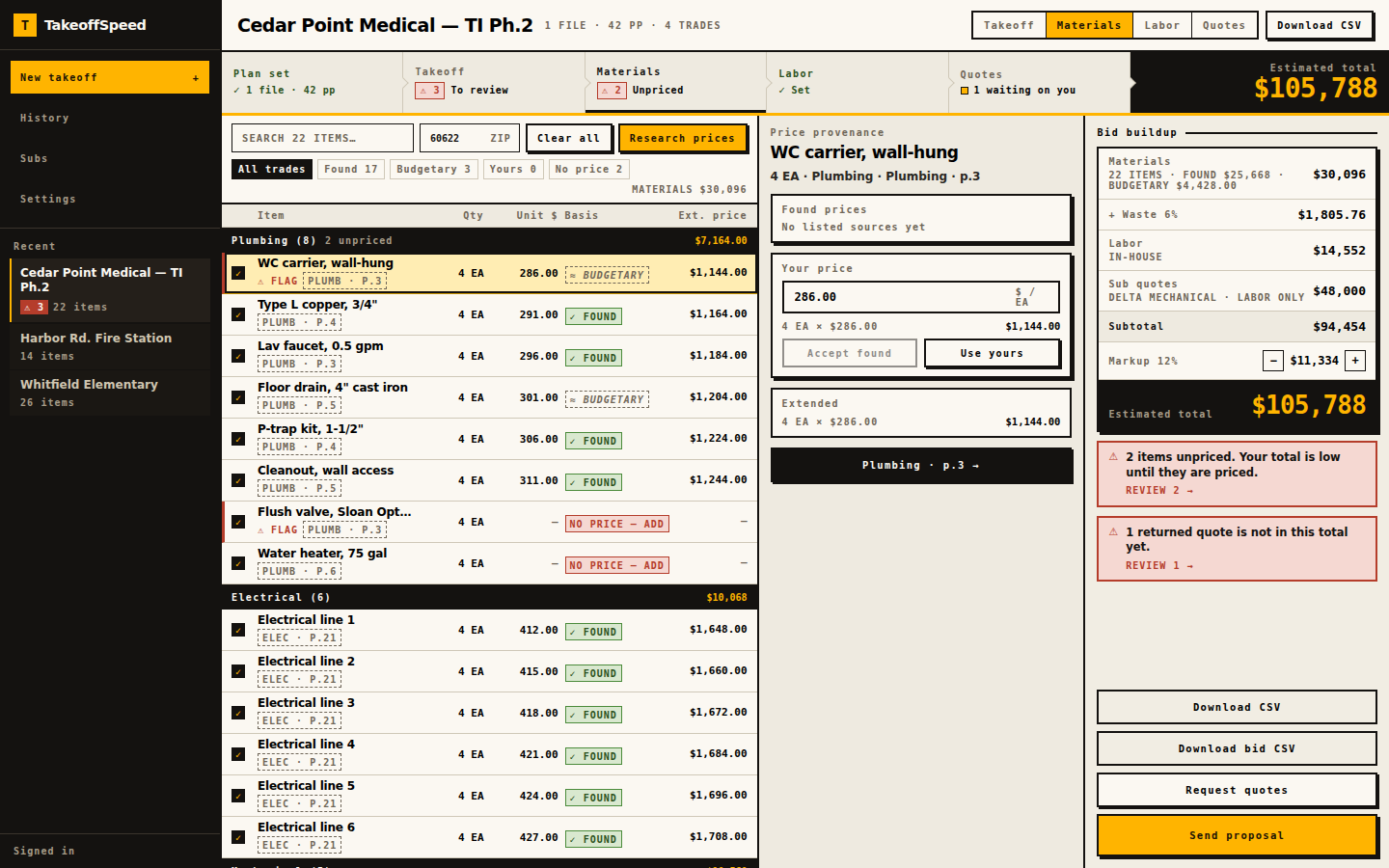
You review a trade-grouped list with page-level citations on high-confidence lines, HIGH / MED / LOW evidence labels, and Needs your eyes for math-mismatch and no-evidence flags. You edit a line when the drawing says otherwise. You source selected materials as FOUND versus BUDGETARY, mark each trade SELF or SUB, and send guest RFQs on SUB work. Apply replace-covered-items or labor-only so plumbing is not in your material column and in the quote. Export CSV or Word. Unpriced lines print an em dash, never $0.00.
See how it works on the walkthrough if you want the screens first. Then run your first bid. If that first takeoff does not earn its keep, email feedback@takeoffspeed.io and the month is refunded. Cancel anytime. Failed runs do not count. We do not run your company. We help you get the bid out.
- Upload the plans.
- Review the takeoff and supporting evidence.
- Price self-performed materials.
- Send RFQs for subcontracted scope.
- Bring the returned quotes into the bid.
- Check coverage and avoid double-counting.
- Assemble and send the proposal.
In the product
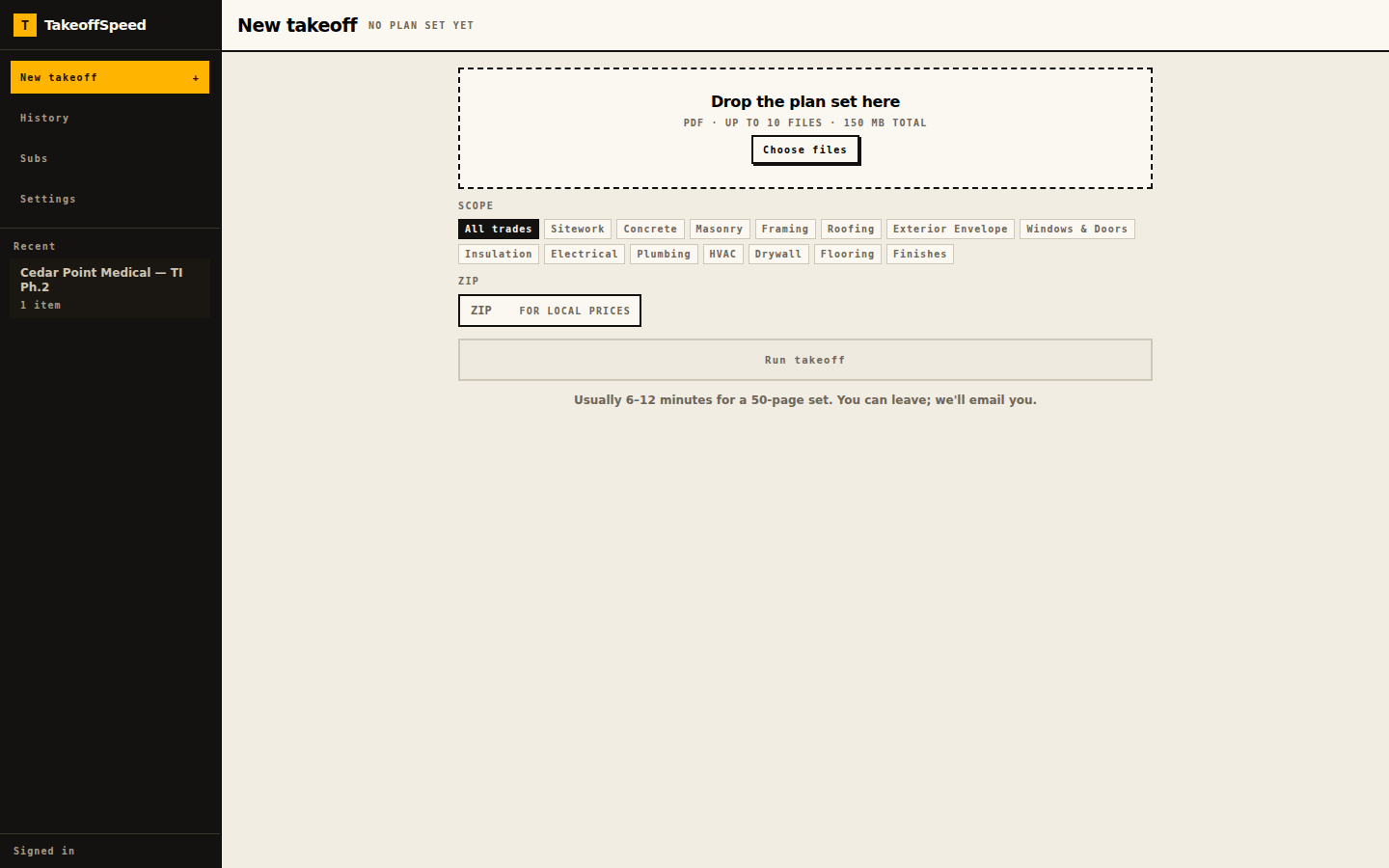
What this supports
Browser-based, no desktop installation. PDF only, up to ten files; 150 MB upload, 200 MB server. The current page allowance is shown before upload. Large or dense sets may exceed processing limits.
The takeoff is grouped by the fourteen scopes from Sitework through Finishes. High-confidence lines carry a page-level citation you can open (a chip like Plumbing · p.3). Confidence is HIGH, MED, or LOW and describes what the system could see in the drawings. Lines with no page are not hidden; they show as no-evidence under Needs your eyes. Math sanity flags call out arithmetic on a row that does not work.
Source researches live retail prices for the lines you run. FOUND is a listed match that passed verification. Budgetary lines stay labeled as estimates. A line with no price says NO PRICE — ADD. You can overwrite a price with your own supplier number. Labor on SELF trades is a suggested hours-and-rate allowance, not a sub’s bid. SUB trades wait on a quote.
Guest RFQs on Solo, Crew, and Shop: quantities and units only, never your prices or other bidders’ names, your letterhead, TakeoffSpeed as a footer, up to fifteen subs per send, a required due date, trade sheets plus cover and site plan — or the full set when sheets cannot be sorted by trade. Apply replace-covered-items or labor-only. Bid arithmetic is one integer-cents function. Additional contingency applies to self-performed material costs only. CSV and Word export live in the product.
Sample output
The ungated example at /sample-bid is the golden tenant fit-out the tests pin — not a second invented job. Title on that page: Sample tenant fit-out. ZIP 34420. Area on the fixture is 1,988 SF. Street address and original project name stay off the page.
You can inspect a trade-grouped table, one returned plumbing quote applied in replace mode so covered plumbing materials do not also sit in the self-performed total, additional contingency at 10%, markup at 15%, and a bid rail whose estimated total is $196,682.14 from computeBidTotals. Plan-page source is empty on this fixture’s takeoff lines; live takeoffs include available page references for review. CSV and Word stay disabled until you sign in.
What this does not do
No scheduling, no payroll, no change-order log, and no company-wide project-management suite. We do not run your company. We help you get the bid out.
The takeoff is a starting point, not a certified quantity survey. A human reviews every line. You are the estimator on this page; the product does not sit in that chair for you. We do not claim coverage for every city or every SKU. FOUND is listed retail at run time, not your negotiated supplier quote. Budgetary is an estimate. Labor suggestions are a basis, not a wage survey. We do not publish an award-rate.
Your first subscription: one free takeoff in a 14-day trial. A credit card is required. Cancel before trial end to avoid billing. Refunds on the first-takeoff guarantee and Sunday-Off are manual via feedback@takeoffspeed.io.